 InspectCam™
Around the house
How to find a leak under the sink
When it drips tells you where: supply lines, faucet, drain or dishwasher.

By , developer of InspectCam™ · Published · Last updated
Empty the cabinet, dry every pipe, then watch when it drips. All the time means the supply lines or shut-off valves. Only while the tap runs means the faucet. Only while water drains means the drain pipes, usually a loose nut. Only with the dishwasher or disposal means those connections. Water with no visible drip is often coming from above. Film the joint with a light on so the plumber can see it too.
A wet cabinet floor tells you there's a leak. It doesn't tell you where. Under a kitchen sink there can be two supply lines, two shut-off valves, a faucet, a drain with several joints, a disposal and a dishwasher hose, all crammed into a dark box. Water runs along pipes before it drips, so where you find it often isn't where it starts.
The quickest way to narrow it down is to notice when it leaks. Each part of the plumbing only carries water at certain times, so the timing points to the part.
Jump to
Empty the cabinet and dry everything
Take everything out of the cabinet. Then dry all of it: the drain pipes, the supply lines, the shut-off valves, the disposal. Ace Hardware's method starts here because you can't see new water on a wet pipe, and a leak sometimes shows itself straight away as water reappears on a surface you've just dried.

One trick from InSinkErator's troubleshooting page: tape a sheet of newspaper flat across the cabinet floor. Any drip leaves a wet spot on the paper, directly under wherever it fell from.

When it drips tells you where
| When it drips | Where to look | Why |
|---|---|---|
| All the time, even with nothing running | Supply lines and shut-off valves | They hold water under pressure whenever the valves are open |
| Only while the tap is running | Faucet connections and the sprayer | They carry water only while the tap is open, and some faucets only leak in certain handle positions |
| Only while water drains | Drain pipes: slip nuts, the trap, where it meets the wall | Drain pipes only carry water when something drains |
| Only when the dishwasher or disposal runs | Dishwasher drain hose, the disposal's connections | They only carry water while those appliances run |
| Water there, but no drip you can find | Above the cabinet: sink-to-countertop seam, countertop joints, water filter | Water can run down from above and collect under the sink |
The last row comes from InSinkErator's list of places to check when a leak isn't where it seems: water filters, the sprayer, the faucet, the dishwasher drain hose, the sink and countertop seam, and countertop joints.
Tests that find most leaks
These come from Ace Hardware and InSinkErator. Do them with the cabinet empty and everything dry.
- Run the tap. Run water in each basin for a few minutes and watch the pipes underneath.
- Fill and drain. Plug the basins, fill them, and leave them full for a while. Then pull the plugs and run the disposal as they drain. Ace calls this the most stress the drain pipes get in normal use.
- Run the dishwasher. Let it run for several minutes and watch where its drain hose joins the plumbing.
- Work the faucet. Turn it on and off several times, moving the handle every way it goes, and try the sprayer. Ace notes that some faucets only leak in a certain position.
If it's the drain, check the slip nuts first. Ace's summary is that most drainpipe leaks come from a loose slip-joint connection.

If it's the garbage disposal
InSinkErator's troubleshooting page splits disposal leaks by where the water appears: at the top where it mounts to the sink, at the discharge pipe, at the dishwasher inlet, or from the bottom. For the bottom, its advice is to check first that the water isn't coming from higher up and running down the unit, most often from the mounting assembly. If it really is from the bottom, it says to contact them.

Film it with the light on
The awkward part is seeing. The joints are at the back of a dark cabinet, you're on your knees, and you need one hand for the light and one for the phone. There's a further problem: many people find their flashlight goes off when they open the camera.
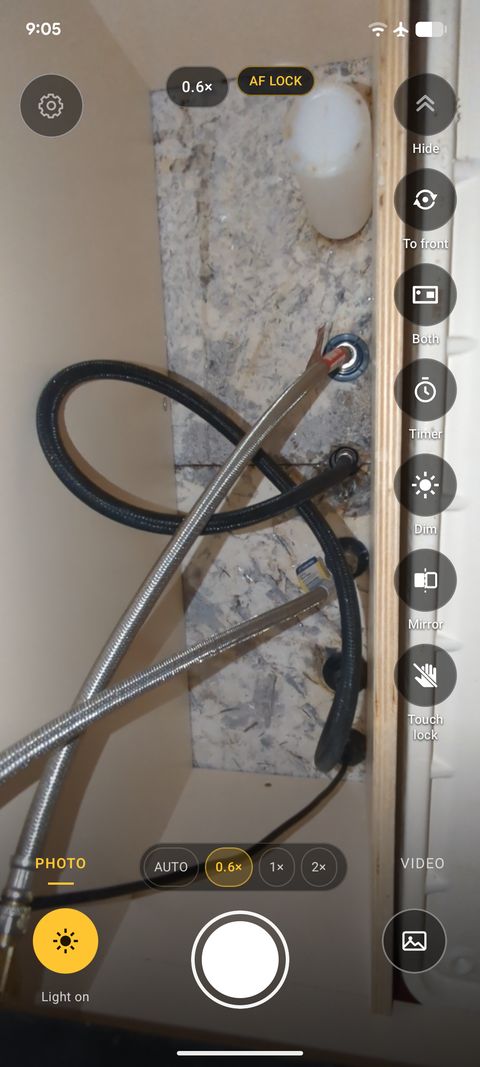
InspectCam™, which I build, opens with the rear camera live and the light already on. For a leak:
- Point it at the joint you suspect and tap to focus on it. Pinch or tap a zoom button to get close. Set focus and zoom before you record.
- Switch to video and record a short clip while someone runs the tap, drains the sink or starts the dishwasher. The light stays on while you record, unless the phone gets very hot.
- Send it from your gallery to your plumber or your landlord, so they can see the drip before they arrive.


The video won't find the leak for you, but it lets you watch a joint closely and replay the moment it drips. If music is playing on your phone, it will be in the video. You can take photos the same way, with the light staying on and no flash; we've checked that on one of our test phones.
How urgent is it?
If water is spraying or spreading across the floor, close the shut-off valve under the sink, or the house main if that doesn't stop it, and call a plumber.
A slow drip usually isn't an emergency, but it isn't harmless either. The EPA's Fix a Leak Week figures say the average household's leaks can waste more than 9,300 gallons of water a year, and a cabinet floor that stays wet is where mold starts. The EPA's advice is to dry water-damaged areas within 24 to 48 hours to prevent mold growth.
Questions people ask
How do I find where a leak under my sink is coming from?
Empty the cabinet and dry every pipe, then notice when it drips. A drip with nothing running points to the supply lines or shut-off valves. A drip only while the tap runs points to the faucet. A drip only while water drains points to the drain pipes, most often a loose slip-joint nut. A drip only when the dishwasher or disposal runs points to those connections.
Why is there water under my sink but no visible leak?
The water may be coming from above. InSinkErator's troubleshooting list includes the water filter, the sprayer, the faucet, the dishwasher drain hose, the seam between the sink and the countertop, and countertop joints. Put a sheet of newspaper on the cabinet floor: wherever a drip lands, it leaves a wet spot you can trace upwards.
Why does my sink only leak when the water is running?
If it drips only while water flows down the drain, the leak is in the drain pipes, and Ace Hardware's guidance is that most drainpipe leaks come from a loose slip-joint connection. If it drips as soon as the tap opens, before much water has gone down the drain, look at the faucet and sprayer connections.
Why is my garbage disposal leaking from the bottom?
First make sure the water isn't coming from higher up and running down the unit, most often from the mounting assembly where the disposal meets the sink. InSinkErator's own advice is to confirm that, and if the leak really is from the bottom, to contact them.
Is a leak under the sink an emergency?
A fast leak or water spreading across the floor is: close the shut-off valve or the house main and call a plumber. A slow drip usually isn't, but it shouldn't wait long. The EPA says the average household's leaks can waste more than 9,300 gallons of water a year, and wet cabinet floors grow mold.
Found a leak somewhere this page doesn't cover? Tell us where it was and it may help the next person.